By Lucas Yoris · Performate
How to Convert Postman Collections into k6 Load Tests (Step by Step)
Learn a reliable Postman to k6 migration workflow, what to validate before scaling traffic, and how Performate speeds up execution.
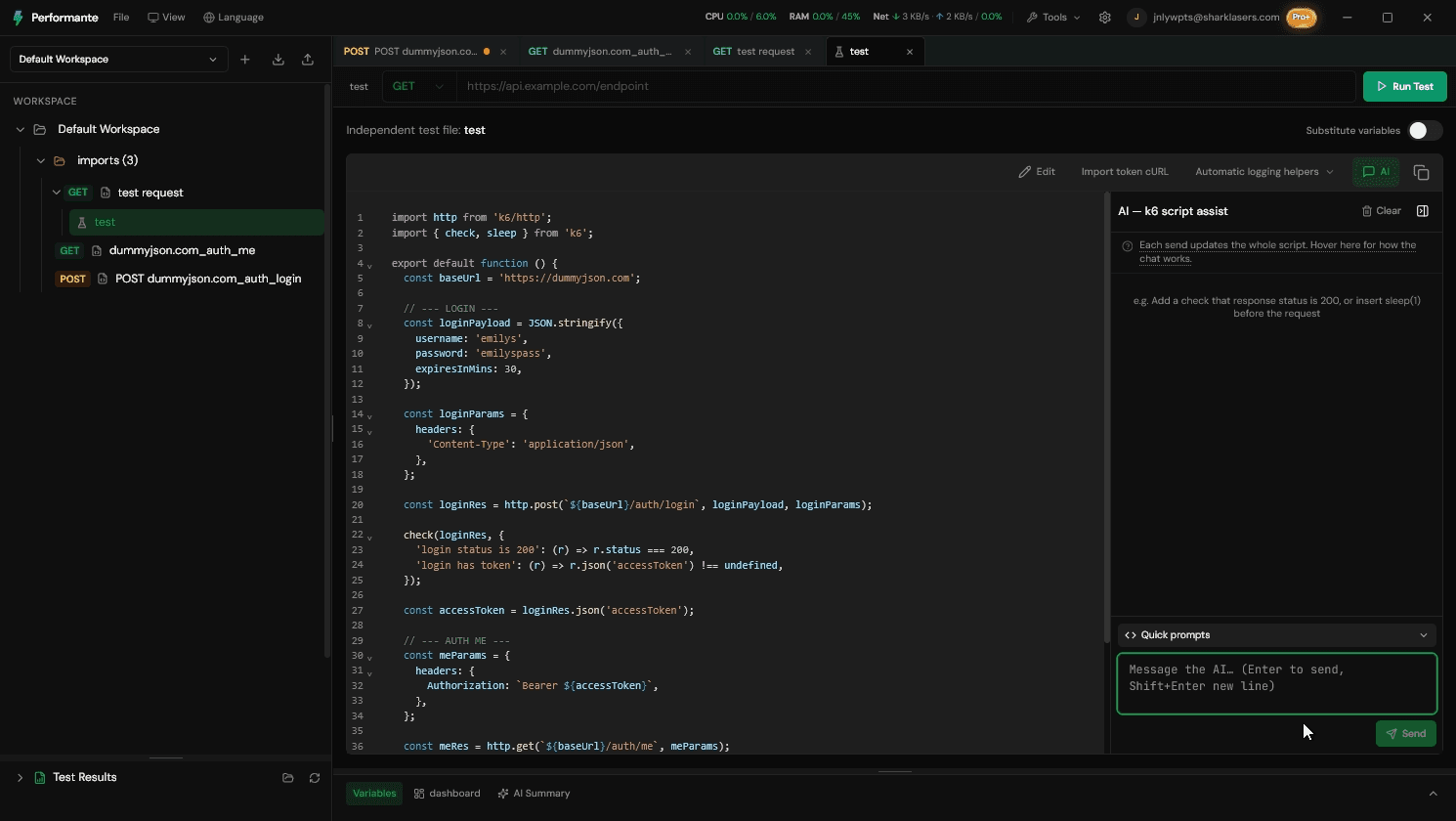
Postman proves your API answers correctly once. k6 proves it survives concurrency, think time, and thresholds—but teams stall at the migration gap: pre-request scripts, collection variables, and chained flows do not map 1:1 to JavaScript.
This step-by-step guide walks import → scenario shape → first meaningful run → CI promotion. You will see what to fix before scaling RPS, how to preserve auth chains, where think time belongs, and how a desktop import saves days over hand-translation. By the end you will have a repeatable checklist—not a one-off script that rots after the second release.
What changes when you move from functional to load testing
Postman runs requests sequentially for a human clicking Send. k6 models virtual users with executors, sleeps, and shared data (scenarios). That shift changes what "passing" means:
- Variables: collection and environment vars become
__ENV, module-level constants, orSharedArrayfor data files—not duplicated secrets committed to git. - Tests tab: Postman assertions become k6
check()calls—thresholds are separate global gates on metrics likehttp_req_duration. - Pre-request JS: often becomes
setup(), helper functions, or init context—review side effects (timestamps, random IDs) that break under concurrency. - Folders: map to scenarios, tags, or exec functions—not always to separate repositories.
Skipping think time produces fake RPS and false confidence; see VU sanity checks before trusting results. Skipping auth chains produces 401 storms that look like server failure.
The migration goal: one meaningful run, not hello world
A meaningful first run has: correct base URL and secrets, working auth, at least one business route under load, think time in the right ballpark, and one threshold product agrees matters. Everything else—stress profiles, multi-region tags—comes after that baseline is green.
Step-by-step k6 conversion (with example)
Example script (illustrative—not production-ready). Migrated login + list flow from a Postman folder named onboarding.
What this demonstrates:
setup()performs login once per test run and passes token to VUs—mirrors Postman collection-level auth without re-login every iteration when tokens are long-lived.- Tags
flow:onboardingmirror Postman folder name for reports and stakeholder filters. constant-vusfor first run—switch toconstant-arrival-rateafter baseline behavior is understood.- Checks on status and JSON shape—converted from Postman Tests tab assertions.
import http from 'k6/http';
import { check, sleep } from 'k6';

const BASE = __ENV.API_BASE || 'https://staging.example.com';

export function setup() {
  const login = http.post(`${BASE}/auth/login`, JSON.stringify({
    email: __ENV.SVC_EMAIL,
    password: __ENV.SVC_PASSWORD,
  }), { headers: { 'Content-Type': 'application/json' } });
  check(login, { 'login ok': (r) => r.status === 200 });
  return { token: login.json('accessToken') };
}

export const options = {
  scenarios: {
    onboarding: {
      executor: 'constant-vus',
      vus: Number(__ENV.VUS || 10),
      duration: '5m',
      tags: { flow: 'onboarding' },
    },
  },
  thresholds: {
    http_req_failed: ['rate<0.01'],
    'http_req_duration{flow:onboarding}': ['p(95)<700'],
  },
};

export default function (data) {
  const headers = {
    Authorization: `Bearer ${data.token}`,
    'Content-Type': 'application/json',
  };
  const list = http.get(`${BASE}/items`, { headers, tags: { route: 'items', flow: 'onboarding' } });
  check(list, {
    'items 2xx': (r) => r.status === 200,
    'items non-empty': (r) => r.json('items').length > 0,
  });
  sleep(Number(__ENV.THINK_SEC || 1));
}
Patterns that work
- Export collection JSON and note auth dependencies per folder before touching k6 syntax.
- Resolve URLs to
__ENV.API_BASEimmediately—hardcoded staging hosts survive exactly one infra rename. - Run 1 VU smoke before ten VUs—fix TLS, DNS, and env issues in seconds.
- Add think time from analytics median—not zero because k6 "feels slow" with sleeps.
- Pick executor for your question (stress vs load vs spike)—do not default to
ramping-vusbecause it sounds impressive.
Anti-patterns to avoid
- Translating every Postman pre-request script verbatim without asking if it runs per-VU or once in
setup(). - Copying production credentials into the repo "just to test quickly."
- Declaring migration done after a 30-second run with no thresholds.
- Maintaining Postman and k6 as divergent sources of truth with no re-import story.
Pro tip (example command): validate env wiring before scaling VUs.
k6 run onboarding.js --vus 1 --duration 30s --env API_BASE=https://staging.example.com
What this command demonstrates: a thirty-second single-VU run surfaces auth and env mistakes without waiting five minutes or flooding staging while you debug a typo in SVC_EMAIL.
Migration checklist
- Export collection; note auth and data dependencies per folder.
- Import to k6 (tool or Performate)—resolve URLs to
__ENV.API_BASE. - Run 1 VU smoke; fix TLS/env issues.
- Add think time from logs or analytics median.
- Pick executor for your question; add one threshold tied to an SLO.
- Export script for CI once thresholds pass locally (smoke/load pipeline).
Decision framework: executor for first migration
| Goal | Start with | Move to when |
|---|---|---|
| Learn script correctness | per-vu-iterations, 1–5 VUs | Wiring is green |
| Match expected concurrency | constant-vus | Product speaks in "concurrent users" |
| Match business RPS | constant-arrival-rate | Analytics gives orders/min or req/s |
| Find breaking point later | ramping-vus stress | After baseline load is stable |
Use per-vu-iterations on day one if the team has never run k6 against this API—fastest failure feedback.
Use constant-arrival-rate when leadership asks "can we handle 500 checkouts per minute?"—open model matches business language.
Defer stress and spike until load scenario passes three consecutive runs without threshold violations.
Observability and validation before scale
Migration failures often appear only at moderate RPS—connection pool limits, rate limits, or missing idempotency. Before inviting QA to review:
- Replace prod credentials with staging secrets (k6 secrets).
- Confirm chained IDs exist in synthetic data (GDPR-friendly data).
- Tag routes matching Postman folder names for report continuity.
- Archive first green run JSON with commit SHA and env profile name.
- Document known fidelity gaps vs production (staging vs prod).
- Verify write paths are idempotent or isolated if reruns share test accounts.
How Performate accelerates Postman → k6
Below is a concrete workflow example for the onboarding flow above—adapt folder names to your collection.
Example: collection to CI-ready script in one desktop session
- Import collection—requests appear grouped by Postman folder. Problem solved: skips hand transcription and missed requests hidden in nested folders.
- Map environments to Performate env profiles—
API_BASE, service credentials, think time defaults. Problem solved: no.envdrift across teammates or "works on my machine" secrets. - Generate k6 with one scenario per folder or merged flow—you choose blast radius. Problem solved: onboarding folder can ship before checkout folder is ready.
- Run smoke in desktop; edit think time visually from analytics notes. Problem solved: faster than edit-run-parse CLI loops during week-one migration.
- Add thresholds when
p95is stable across three runs—product sign-off on one line. Problem solved: gate discipline before CI promotion. - Export to repo for CI pipeline—same script the desktop validated. Problem solved: merge gates match local evidence.
That workflow maps directly to the cta in this post: convert your Postman collection into a runnable k6 test in minutes—not days of manual translation.
Closing takeaway
Postman → k6 is a workflow migration: variables, auth, checks, then executors—not a one-time export. Import, smoke at low VUs, add realistic think time, then scale arrival rate—not the other way around.
Convert your noisiest Postman folder this week, run ten VUs for five minutes, and only then invite QA to review the exported report.
Try Performate free | Book a demo | Desktop Postman → k6 → reports
Ready to optimize your API performance?
Download Performate and convert your Postman collection into a runnable k6 test in minutes.